
There are many reasons why your engine light could illuminate. It could be a simple fix or something more complicated which could cause more problems to your engine and other parts of your vehicle down the road. As a rule of thumb, you should have your vehicle looked at by our factory trained and ASE Certified Technicians as quickly as possible once your engine light illuminated. You do not want to end up on the side of the road needing a tow because you ignored that dreaded engine light.
What is the Purpose of My Car’s Check Engine Light?
Your engine light comes on as a warning that your vehicle needs attention. The engine light electronically communicates with many parts of your car including sensors, the exhaust system, emissions, engine, fuel system, and many more.
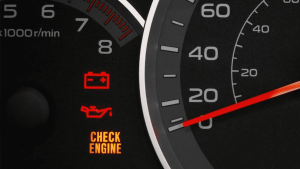
Understanding the essence of car maintenance, especially when the check engine light activates, is crucial for several nuanced reasons. This illumination is a communication form, a vehicle’s pre-emptive strike in highlighting an issue that requires attention.
Addressing it promptly not only ensures the longevity of the car but significantly enhances safety parameters. Unchecked, the underlying complications might magnify, impacting other systems and potentially escalating repair costs. Moreover, this proactive approach sustains the vehicle’s performance, contributing to its energy efficiency, and by extension, playing a part in ecological conservation.
It’s akin to a health check-up, a small step in preventive care that maintains the intricate balance and overall well-being of your vehicle’s ecosystem.
We never recommend driving more than you have to with your check engine light illuminated. As it is a warning light, it could mean a part of your essential vehicle systems has failed or is about to fail. You could cause more damage, causing higher repair costs, if you continue to drive your vehicle with this light illuminated. Our state of the art equipment can quickly determine why this pesky light has illuminated your dashboard.
 Since the check engine light is connected to most of your vehicle’s systems, it is difficult to determine exactly what has caused it to turn on without proper diagnostic equipment and training. A few more common issues are:
We offer an easy repair solution to determining why your check engine light is on. Our state of the art equipment can quickly and efficiently diagnose your vehicle and its check engine light system. It provides us with the diagnostic fault codes required to follow service procedures and make the necessary repairs or services to your vehicle. Our Milpitas ASE Certified Technicians will get you back on the road quickly and affordably.
Milpitas drivers often depend on their vehicles for short city errands, Highway 237 traffic, Interstate 880 commuting, and repeated stop-and-go trips around Main Street, Great Mall Parkway, and Calaveras Boulevard. Those mixed driving patterns can make a check engine light feel unpredictable, especially when the car seems to run almost normally. In reality, that warning may point to an emissions issue, fuel system imbalance, sensor failure, ignition misfire, or another fault that can become more expensive if it is ignored. A professional diagnosis helps separate minor problems from situations that can damage the catalytic converter or reduce reliability during your daily routine. If your vehicle already feels rough at idle, slow to accelerate, or less efficient than usual, pairing a check engine inspection with BYOC’s broader Milpitas auto repair service can speed up the path to a complete fix. Drivers who are overdue for maintenance may also benefit from reviewing the shop’s full auto service options and comparing symptoms with related systems like oil service and brake service so small issues do not stack up into a larger repair bill.
A check engine light does not appear for one single reason, and local driving habits around Milpitas can contribute to several different fault patterns. Repeated short trips may keep the engine from reaching ideal operating temperature for long enough, while heavy traffic and frequent idling can expose weak ignition components, fuel delivery issues, and emissions problems. On older vehicles, a loose gas cap, aging oxygen sensor, or evaporative emissions leak may trigger the light even before the car develops severe drivability symptoms. On higher-mileage vehicles, the warning can show up alongside rough shifting, poor throttle response, or vibration that overlaps with needs for check engine diagnostics, wheel alignment, or tire-related inspections from the tire services page. If your vehicle is part of a business fleet or sees constant local use, it is smart to coordinate warning-light concerns with preventive inspections through BYOC’s fleet service program. The goal is not just to clear a code. It is to understand what changed, why the system flagged it, and how to restore dependable performance before you are stranded in the middle of a workday.
Good diagnostics are more than plugging in a scan tool and reading a fault code. A proper check engine inspection should include code retrieval, symptom confirmation, live data review, visual inspection, and follow-up testing that points to the real cause instead of guessing at parts. That matters because the same dashboard light can be triggered by multiple related systems, and replacing components without testing can waste time and money. At a shop that handles complex drivability concerns, the process often overlaps with related systems such as emissions components, ignition parts, charging performance, and computer controls. If testing reveals the problem connects to a worn ignition system, fuel quality issue, or a maintenance gap, the repair plan may naturally tie into routine maintenance, broader service diagnostics, or vehicle-specific issues addressed through the main BYOC Auto Repair homepage. Drivers comparing shops can also use the about page and contact page to confirm location, experience, and scheduling details before booking. Clear diagnostics should leave you with a practical explanation, a verified repair recommendation, and a realistic sense of urgency.
Some check engine light situations are inconvenient but manageable for a short trip to a repair facility. Others require immediate caution. If the light is flashing, the engine is misfiring, the vehicle is shaking, or you notice a burning smell, severe power loss, or unusually loud exhaust noise, continued driving can increase the risk of catalytic-converter damage or leave you stuck unexpectedly. That is especially risky when you rely on your car for freeway commuting through Milpitas, Santa Clara, Fremont, and nearby business corridors. In those cases, scheduling service quickly through BYOC’s contact page is the safest move. If the concern appears alongside brake feel changes, unstable handling, or suspension problems, it can also make sense to review related services such as brake repair, wheel alignment service, and the broader Milpitas repair page. Drivers with hybrid concerns or specialty system warnings can also explore hybrid battery services. Fast attention protects reliability, helps control repair costs, and gives you a better chance of solving the underlying problem before it spreads into other systems.